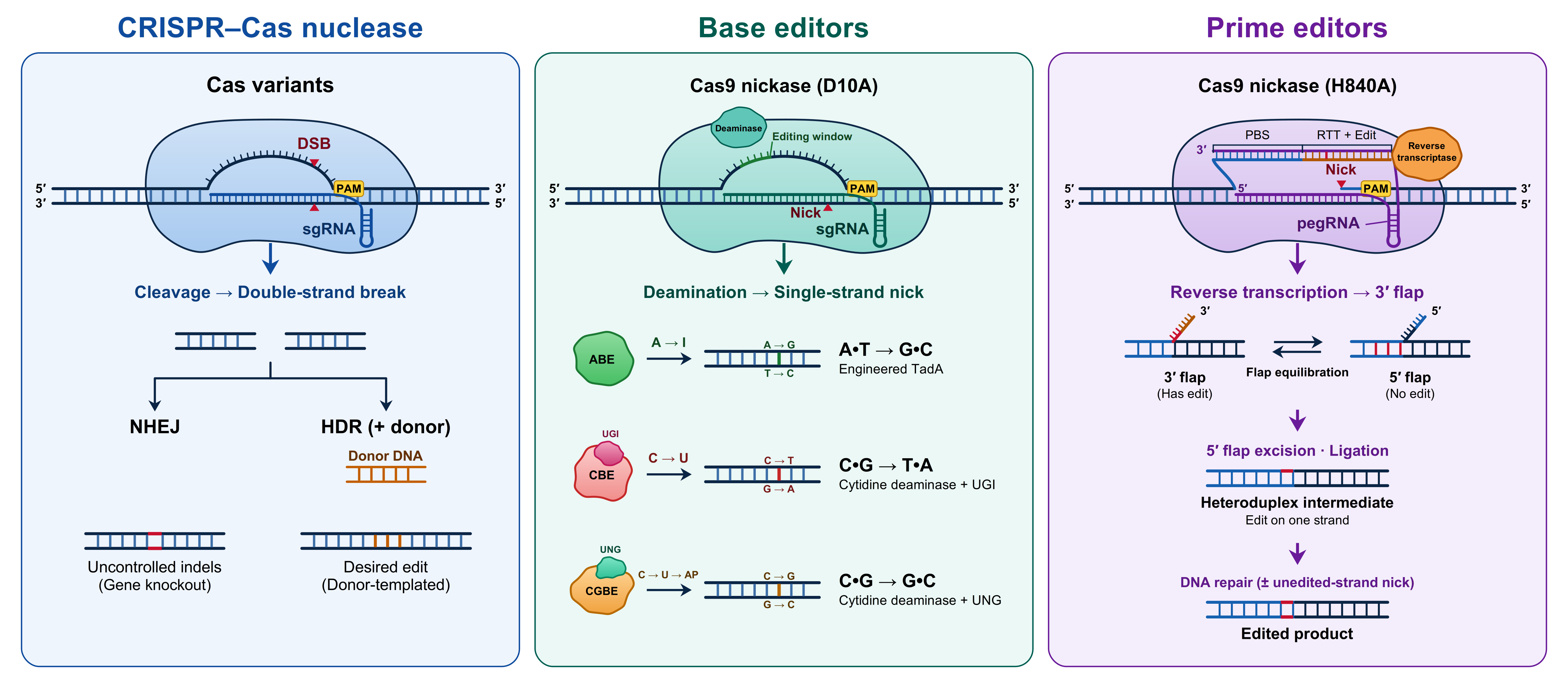
DeepGE is a unified web server that integrates multiple genome editing tools into a single, user-friendly interface. It allows you to design and evaluate guide RNAs for CRISPR–Cas9 Variants, Base Editors, and Prime Editors seamlessly. The system takes one input in any of nine formats — FASTA, Gene Symbol, NMID, Ensembl ID, HGNC ID, Genomic Position, Edit Sequence, ClinVar ID or COSMIC ID — dispatches it to each selected tool, and presents all results in a unified view.
Beside the per-mode settings, the controls DeepGE carries are shared ones, and each reaches the legs it applies to under its own name: the input format, the species and the cloning-oligo settings reach all three legs, the genome-wide off-target search reaches the CRISPR–Cas9 and base-editing legs, the donor settings reach the CRISPR–Cas9 leg, and the pegRNA form and its motif panel reach the prime-editing leg.
When one or two of the selected modes happen to fail (for example, because the input is too short for such prediction), the others still complete — DeepGE only fails the whole job when every selected mode fails.
Homology-directed repair (HDR) donor templates. When an input format describes an intended edit — an unedited/edited sequence pair, ClinVar ID or COSMIC ID — the CRISPR–Cas9 Variants results also carry what each guide needs for HDR: the cut site, the cut-to-edit distance, the donor template in the chosen type and orientation(s) (default: a single-stranded oligo on the sense strand, 100 nt homology arms each side), the realised arm lengths, an optional PAM-blocking mutation, and the candidate's rank among the target's guides. There is no HDR mode switch: the input format decides.